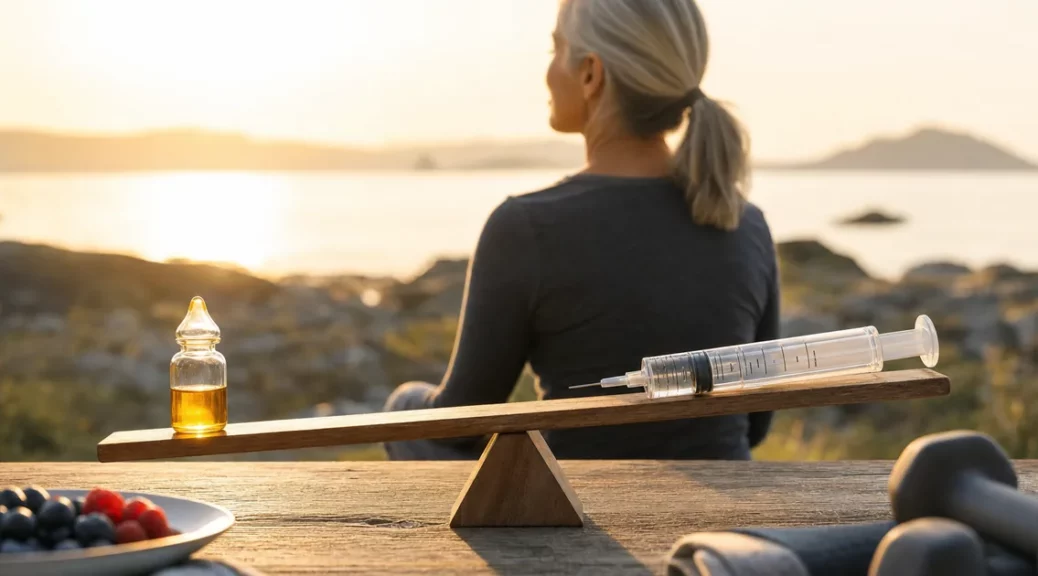
The Hormone Paradox After 40: The Estrogen Women Fear Is Protective, the Growth Hormone People Chase Is Not
Two hormone stories landed within months of each other, and they point in opposite directions. The estrogen that millions of women were taught to fear turns out, in its low-dose vaginal form, to be associated with fewer serious infections and fewer deaths in older women. Meanwhile, the growth hormone that longevity clinics sell as a fountain of youth extended lifespan in a new mouse study only when researchers blocked it. Together they teach one lesson: with hormones, dose, route, and context decide everything, and gut instinct is a poor guide.
Vaginal estrogen: the feared hormone with a protective record
After menopause, falling estrogen levels thin the tissue of the vagina and urethra and shift the local microbiome away from protective lactobacilli. The practical consequence is a sharp rise in recurrent urinary tract infections, which in older women can escalate into hospitalization and sepsis rather than staying a painful nuisance.
Established evidence
The core trial is old and remarkably clear. In a randomized, double-blind, placebo-controlled trial published in the New England Journal of Medicine in 1993, Raz and Stamm gave postmenopausal women with recurrent UTIs a low-dose intravaginal estriol cream. Infections dropped from 5.9 to 0.5 episodes per patient-year, and lactobacilli returned in 61 percent of treated women versus none on placebo. Three decades later, the AUA/CUA/SUFU guideline on recurrent uncomplicated UTIs, updated in 2025, tells clinicians to recommend vaginal estrogen to peri- and postmenopausal women with recurrent UTIs when there is no contraindication.
The regulatory picture finally caught up. In November 2025 the FDA announced it would remove the boxed warning that had sat on vaginal estrogen since the systemic hormone therapy scares of the early 2000s, and approved updated labels in early 2026. The warning had cited risks (stroke, clots, cancer) that apply to systemic dosing, not to low-dose local therapy, from which very little estrogen reaches the bloodstream.
Emerging evidence
A retrospective analysis of the Epic Cosmos database, presented at the 2025 American Urological Association meeting and since published in Urology, examined over two million records of women with recurrent UTIs. Among women over 55, those prescribed vaginal estrogen had lower rates of sepsis (10.6 versus 19.4 percent), hospitalization (4.06 versus 5.16 percent), and death (0.42 versus 1.54 percent) than non-users. This is observational data; women who receive the prescription may differ in access to care and overall health, so the effect size should be held loosely. But the direction matches the trial evidence and the mechanism.
Growth hormone: the anti-aging pitch that lifespan biology contradicts
Growth hormone declines with age, which makes "restore it" an easy sell. The biology of aging says something closer to the opposite.
Established evidence
Mice engineered to lack growth hormone signaling are among the longest-lived laboratory mice known, a finding replicated across models for two decades. Humans offer a natural experiment: in an Ecuadorian cohort with Laron syndrome, whose growth hormone receptors do not work, researchers documented one non-lethal cancer and no diabetes over 22 years, against 17 percent cancer and 5 percent diabetes in their normal-statured relatives (Science Translational Medicine, 2011).
On the other side of the ledger sits the study that launched a thousand clinics. Rudman's 1990 NEJM trial gave growth hormone to men over 60 and reported more lean mass and less fat. Less quoted: systolic blood pressure and fasting glucose rose significantly, and no lifespan benefit has ever been shown in humans.
Emerging evidence
In September 2026, the Kopchick laboratory (the group whose work produced pegvisomant, the FDA-approved growth hormone blocker for acromegaly) published a new study in Aging Cell. Transgenic mice expressing a growth hormone receptor antagonist lived significantly longer, with maximal lifespan extended by 186 days in males and 265 days in females; on a mouse timescale, that is roughly a 20 to 25 percent stretch of the outer limit. At two years old, these mice were less frail and had stronger grip than controls despite carrying more fat. Blocking the "youth hormone" made old mice more functional, not less. No human longevity trial of growth hormone antagonism exists, so this stays firmly in the emerging column.
A four-step filter for any hormone claim
The two stories reward the same reading method, which you can apply to the next hormone headline you meet.
- Name the exact molecule, dose, and route. "Estrogen" is not one thing: oral systemic estradiol and low-dose vaginal estriol have different absorption, risks, and evidence. Injected growth hormone and a growth hormone blocker are opposites.
- Find the strongest evidence type. A randomized trial with hard outcomes beats genetics, which beats animal models, which beat observational databases, which beat mechanism talk.
- Check who the evidence covers. Postmenopausal women with recurrent UTIs, or transgenic mice? Your distance from the studied population is your uncertainty.
- Classify before acting. Established, emerging, or experimental; then act only at the level the evidence supports.
A composite case: one couple, two hormone decisions
Marie, 61, has had three UTIs in twelve months, each treated with antibiotics, none followed by prevention. Under the 2025 AUA guideline, vaginal estrogen is precisely the option her clinician should raise; the trial evidence predicts her episode count could fall by an order of magnitude. Her partner Marc, 58, was offered "growth hormone peptide therapy" at a wellness clinic to "restore youthful levels." The strongest lifespan data available point the other way, and the one rigorous human trial of the restore-it approach showed rising glucose and blood pressure. Same decade of life, same word "hormone," opposite evidence-based answers.
Mistakes to avoid
- Reading 2002 into 2026. Applying the Women's Health Initiative systemic-therapy fears to low-dose vaginal estrogen kept an effective therapy from women for two decades; even the FDA has now walked the warning back.
- The mouse-to-human shortcut. The Aging Cell result does not mean anyone should seek growth hormone blockers for longevity. It means the direction of the "boost GH" pitch is unsupported.
- Restoring youthful levels as a goal. A hormone that declines with age is not automatically a deficiency to correct. Rudman's trial is the cautionary tale.
- Biomarker theater. A rising IGF-1 or a "younger hormone panel" is not an outcome. Infections prevented, function preserved, glucose stable: those are outcomes.
- Quitting after relief. In the trials, vaginal estrogen protected while it was used, on a maintenance schedule. Stopping at first symptom relief forfeits the benefit.
What you can actually observe
Useful markers here are concrete. For recurrent UTIs: episodes per year against your own baseline (the trial benchmark is a drop from roughly six to one every two years), plus symptom relief in dryness and urgency within weeks. For anyone tempted by growth hormone: fasting glucose, systolic blood pressure, and IGF-1 if prescribed anything that moves it, since the documented harms show up exactly there. For function at any age: grip strength, measurable with a 30-euro dynamometer, the same marker that improved in the long-lived mice.
Where personal experimentation fits
Personal experimentation has a place in this story, but a narrow one: tracking your own UTI frequency, symptom scores, grip strength, glucose, and blood pressure, and bringing that log to a clinician. Starting prescription hormone therapy is a medical decision, not a self-experiment; and taking growth hormone for anti-aging is not reasonable experimentation at all, because the risk signal already points the wrong way.
The practical takeaways: if you or a woman in your life has recurring UTIs after menopause, the guideline-backed conversation to have with a clinician is about low-dose vaginal estrogen. If anyone offers you growth hormone for longevity, ask for one human study with hard outcomes; there is none. And for every future hormone claim, run the four-step filter before your wallet or your fear decides for you.
Thrive Through Time publishes evidence-first longevity analysis; the monthly newsletter is free.
Sources
- Raz R, Stamm WE. A controlled trial of intravaginal estriol in postmenopausal women with recurrent urinary tract infections. NEJM, 1993. https://www.nejm.org/doi/full/10.1056/NEJM199309093291102
- American Urological Association. Recurrent Uncomplicated Urinary Tract Infections in Women: AUA/CUA/SUFU Guideline (2025 amendment). https://www.auanet.org/guidelines-and-quality/guidelines/recurrent-uti
- Medscape. Sharp drop in sepsis, mortality when older women use vaginal estrogen for recurrent UTIs (AUA 2025). https://www.medscape.com/viewarticle/sharp-drop-sepsis-mortality-when-older-women-use-vaginal-2025a1000a8n
- Urology (2026). Vaginal estrogen prescription is associated with reduced risk of serious adverse outcomes in women with recurrent urinary tract infection: an Epic Cosmos database analysis. https://www.sciencedirect.com/science/article/pii/S0090429526003584
- FDA. FDA approves labeling changes for menopausal hormone therapy products (2025-2026). https://www.fda.gov/news-events/press-announcements/fda-approves-labeling-changes-menopausal-hormone-therapy-products
- List EO, et al.; Kopchick JJ. Growth Hormone Receptor Antagonism Extends Lifespan. Aging Cell, September 2026. https://pubmed.ncbi.nlm.nih.gov/42701998/
- Guevara-Aguirre J, et al. Growth hormone receptor deficiency is associated with a major reduction in pro-aging signaling, cancer, and diabetes in humans. Science Translational Medicine, 2011. https://pubmed.ncbi.nlm.nih.gov/21325617/
- Rudman D, et al. Effects of human growth hormone in men over 60 years old. NEJM, 1990. https://www.nejm.org/doi/full/10.1056/NEJM199007053230101
- Bartke A. Growth hormone and aging. Reviews in Endocrine and Metabolic Disorders, 2021. https://link.springer.com/article/10.1007/s11154-020-09593-2
- Attia P. Vaginal estrogen: a potentially life-saving therapy. PeterAttiaMD.com, 2026. https://peterattiamd.com/vaginal-estrogen/