Creatine and the Aging Brain: Separating a Real Signal From Supplement Hype
Scroll through any longevity feed this month and you will meet a supplement promising "+143% brain plasticity after one dose" or a nootropic stack that flips your brain's "focus switch." Meanwhile, a much quieter literature has been building around one of the cheapest, most-studied molecules in sports nutrition: creatine. Two reviews published in 2026 have now mapped what we actually know about creatine and the aging brain, and the honest picture is more interesting than either the hype or the dismissals.
Why the brain's energy budget matters after 40
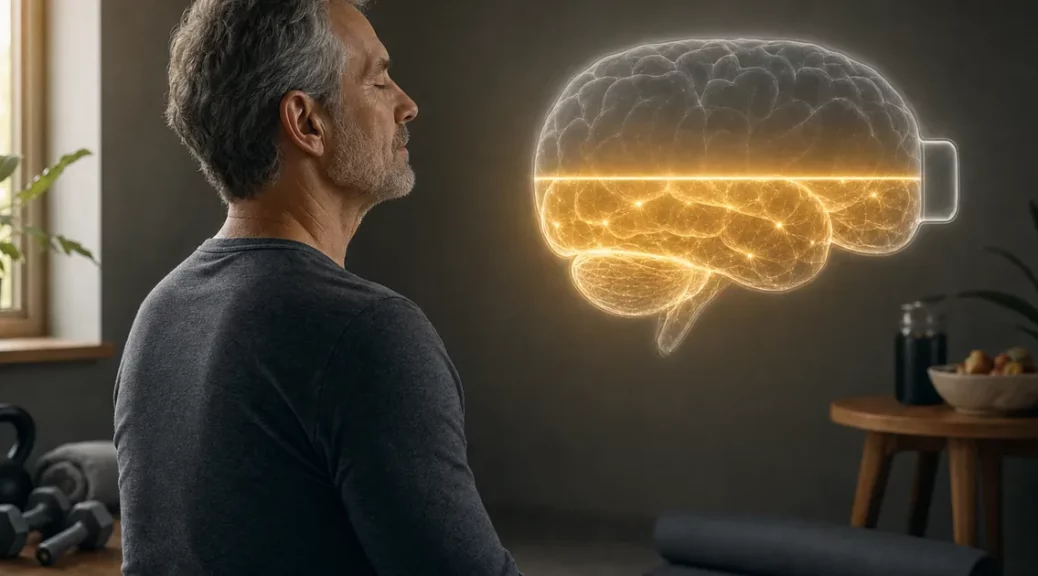
Your brain is roughly 2 percent of your body weight but consumes around 20 percent of your energy. It buys that energy through the same phosphocreatine system your muscles use during a heavy set: creatine phosphate donates a phosphate group to regenerate ATP, fast, exactly when demand spikes. Memory encoding, task switching, and holding a plan in mind while distractions pile up are all energetically expensive operations.
That system is not static across life. Cellular energy metabolism becomes less efficient with age, and impaired brain energy metabolism is one of the shared features across dementia subtypes highlighted in a scoping review published in Ageing Research Reviews in August 2026. This is the mechanistic reason researchers keep coming back to creatine for the brain: it is not a stimulant or a "focus chemical," it is a buffer for the energy system everything else depends on.
Established evidence: what creatine is proven to do
Before the brain claims, the settled part. Creatine monohydrate is among the most-studied supplements in existence, with more than 500 peer-reviewed publications behind it. The 2021 review by Antonio and colleagues in the Journal of the International Society of Sports Nutrition concluded that 3 to 5 g per day is well tolerated, does not damage healthy kidneys, and reliably improves strength and lean mass outcomes when combined with resistance training. For adults over 40 trying to preserve muscle, that alone justifies its place on the shelf.
What is established for muscle, however, is not yet established for cognition. That distinction is exactly where most marketing blurs the line.
Emerging evidence: the brain data, study by study
Memory in older adults looks like the real signal
A 2023 meta-analysis by Prokopidis and colleagues in Nutrition Reviews pooled randomized controlled trials and found that creatine improved memory measures versus placebo, with the effect driven largely by older adults aged 66 to 76; younger participants showed no benefit. A published letter later challenged the statistics for double-counting outcomes, so treat the effect size as promising rather than proven. Still, a 2026 systematic review in the same journal, covering six studies and 1,542 participants, reached a compatible conclusion: the most consistent cognitive benefit appears in older adults, particularly for memory, with little measurable effect in healthy young people.
The largest trial in healthy adults says: modest at best
The biggest randomized trial to date, published by Sandkühler and colleagues in BMC Medicine in 2023, gave 123 healthy adults 5 g per day for six weeks in a crossover design. The result: a small benefit at best, bordering on statistical significance for working memory and absent for reasoning. Vegetarians, often assumed to be super-responders, did not benefit more than omnivores. If you are 45, well rested, and eating meat, daily creatine is unlikely to make you feel smarter.
Where it shines: a stressed brain
The picture changes when the brain is under energetic stress. In a 2024 Scientific Reports study, Gordji-Nejad and colleagues gave participants a single large dose of creatine (0.35 g per kg of body weight) during 21 hours of sleep deprivation. Measured by magnetic resonance spectroscopy, cerebral high-energy phosphates held up better, and processing speed improved compared with placebo. That dose is a research protocol, not a recommendation, but the mechanism matters: creatine seems to help most precisely when demand outstrips supply.
Alzheimer's: a promising pilot, not a treatment
The University of Kansas CABA pilot, published in 2025 in Alzheimer's & Dementia: Translational Research & Clinical Interventions, gave 20 patients with Alzheimer's disease 20 g of creatine monohydrate daily for eight weeks. Brain total creatine rose by 11 percent, and several cognitive scores improved. But it was a single-arm study with no placebo group, so it proves feasibility, not efficacy. The August 2026 scoping review puts this in sobering context: after screening 8,317 records on creatine and dementia-related cognition, the authors found only six eligible studies, and not a single randomized controlled trial in humans with dementia. Anyone selling creatine as dementia protection is selling ahead of the data.
How a 10-person study becomes a "143 percent" miracle
Compare that slow, careful accumulation with the claim currently circulating on YouTube: whole coffee fruit extract raising "brain plasticity" by 143 percent in an hour. The underlying study is real. Reyes-Izquierdo and colleagues, in the British Journal of Nutrition in 2013, gave a single 100 mg dose of whole coffee fruit concentrate and measured a 143 percent rise from baseline in plasma BDNF within about an hour, in roughly ten subjects per group, in work conducted by researchers affiliated with the ingredient's manufacturer.
Read the details and the claim deflates: plasma BDNF is not brain BDNF; the spike was transient; no memory, attention, or learning outcome was ever measured; and the sample was tiny. The same pattern applies to most "focus switch" nootropic stacks aimed at midlife professionals: a plausible mechanism, a small acute biomarker study, and a leap to lasting cognitive benefit that no trial has demonstrated. Creatine's brain literature, for all its gaps, has something those products lack: independent replication attempts, dose-response imaging data, and published critiques of its own weakest analyses.
Personal experimentation: an eight-week protocol worth running
Here is a defensible way to test creatine on yourself, framed as an experiment rather than a treatment. Consider a 52-year-old who lifts three times a week, sleeps six and a half hours, and wants sharper afternoons; this is the profile most likely to notice anything.
- Establish a baseline for two weeks. Pick two or three observable markers: a free digit-span or dual-n-back score tested at the same hour, your main lifts' working weights, and a 1-to-10 rating of afternoon mental energy logged daily.
- Take 5 g of creatine monohydrate daily, any time of day, with food. Skip loading phases; they only speed up saturation by a week or two.
- Change nothing else for eight weeks. Muscle saturates in about four weeks; brain creatine appears to rise more slowly, which is why short self-tests feel disappointing.
- Re-test at week eight under the same conditions, ideally including one poorly slept day, since sleep-deprived performance is where the data suggest creatine earns its keep.
- Decide on evidence. Expect roughly 1 kg of scale weight from intracellular water and, plausibly, steadier performance when tired. If nothing moved, you have a clean personal null result for about 15 euros.
If you have kidney disease or take medication, talk to your physician before starting; that is a data-quality decision as much as a safety one.
Mistakes to avoid
- Expecting a stimulant. Creatine is a reservoir, not caffeine. Judging it after five days is the most common reason people quit.
- Paying extra for "advanced" forms. HCl, buffered, and micronized-plus-peptide versions have no superiority data; every study cited above used plain monohydrate.
- Panicking over a creatinine blood test. Creatine supplementation raises creatinine, its breakdown product, without indicating kidney damage; tell whoever orders your labs.
- Substituting it for sleep and training. Every effect discussed here is smaller than the cognitive cost of chronic short sleep or the benefit of regular exercise.
- Chasing acute biomarker headlines. A one-hour plasma spike, whether BDNF or anything else, is not a cognitive outcome. Ask what the trial measured and for how long.
The bottom line for your next eight weeks
Creatine will not make a healthy midlife brain superhuman, and it is not a dementia therapy. But it is cheap, exceptionally well characterized for safety at 3 to 5 g per day, clearly useful for the muscle you are trying to keep, and backed by converging, if unfinished, evidence for memory in older adults and for cognition under sleep deprivation. That combination makes it one of the rare supplements where a structured self-experiment is rational right now: define your markers this week, buy plain monohydrate, and let your own eight-week data, not a thumbnail promising 143 percent, decide whether it stays in your routine.
Sources
- Prokopidis K, et al. Effects of creatine supplementation on memory in healthy individuals: a systematic review and meta-analysis. Nutrition Reviews, 2023. https://academic.oup.com/nutritionreviews/article/81/4/416/6671817
- Sandkühler JF, et al. The effects of creatine supplementation on cognitive performance: a randomised controlled study. BMC Medicine, 2023. https://link.springer.com/article/10.1186/s12916-023-03146-5
- Gordji-Nejad A, et al. Single dose creatine improves cognitive performance and induces changes in cerebral high energy phosphates during sleep deprivation. Scientific Reports, 2024. https://www.nature.com/articles/s41598-024-54249-9
- Smith AN, et al. Creatine monohydrate pilot in Alzheimer's: Feasibility, brain creatine, and cognition. Alzheimer's & Dementia: Translational Research & Clinical Interventions, 2025. https://alz-journals.onlinelibrary.wiley.com/doi/10.1002/trc2.70101
- The Cognitive Effects of Creatine Supplementation in Older Adults and Preclinical Models of Dementia: A Scoping Review. Ageing Research Reviews, 2026. https://doi.org/10.1016/j.arr.2026.103317
- Creatine and Cognition in Aging: A Systematic Review of Evidence in Older Adults. Nutrition Reviews, 2026. https://academic.oup.com/nutritionreviews/article/84/2/333/8253584
- Antonio J, et al. Common questions and misconceptions about creatine supplementation: what does the scientific evidence really show? Journal of the International Society of Sports Nutrition, 2021. https://pubmed.ncbi.nlm.nih.gov/33557850/
- Reyes-Izquierdo T, et al. Modulatory effect of coffee fruit extract on plasma levels of brain-derived neurotrophic factor in healthy subjects. British Journal of Nutrition, 2013. https://pubmed.ncbi.nlm.nih.gov/23312069/