Your Gait Speed Is a Brain Test You Can Run at Home
Most people over 40 who care about longevity now track apoB, VO2max, sleep stages and grip strength. Almost nobody tracks how fast they walk across a room. That is a gap, because gait speed is cheap to measure, repeatable at home, and in large cohorts it tracks with both survival and future cognitive decline. It is not a diagnosis and it is not destiny; it is a number that moves when you train, which is exactly what makes it worth logging.
Established evidence: what gait speed actually predicts
The anchor study is a pooled analysis of nine cohorts published in JAMA in 2011: individual data from 34,485 community-dwelling adults aged 65 and older, followed for 6 to 21 years, mean gait speed 0.92 m/s. Survival rose in steps across the full range of walking speed, with each 0.1 m/s increment associated with better survival. Predicted survival from age, sex and gait speed alone was about as accurate as models using chronic conditions, blood pressure, BMI, smoking and hospitalisation history.
Gait also slows long before anyone notices a memory problem. In a cohort of 204 healthy older adults followed for roughly nine years, 46% converted to mild cognitive impairment; modelling put the acceleration in gait-speed decline at about 12 years before MCI onset. And in the ASPREE cohort of roughly 17,000 adults aged 65 and over, participants who declined on both gait speed and memory had a higher dementia risk than those declining on either one alone.
Two numbers make this practical. Perera and colleagues estimated that a small meaningful change in gait speed is around 0.05 m/s and a substantial change around 0.10 m/s. And in 439 older adults followed for eight years, those who improved usual gait speed by at least 0.1 m/s over one year had 31.6% mortality versus 49.3% in those who did not improve (adjusted hazard ratio 0.42). Improvement, not just baseline, carried information.
For reference values, a descriptive meta-analysis of 41 studies (23,111 people) reported comfortable walking speed averaging about 1.43 m/s for men in their 40s, declining across decades to roughly 0.94 m/s for women aged 80 and above.
A late marker versus an early one
There is a useful parallel in cardiology. Peter Attia recently argued that a coronary calcium score of zero should not reassure a younger adult with a long history of high LDL-C, because calcification is a late event in atherosclerosis. He points to CARDIA data published in JACC in 2025: among participants with a calcium score of zero at year 25, the highest cumulative LDL-C exposure quartile had a 3.36-fold higher adjusted risk of cardiovascular events than the lowest.
Cognition works the same way. A normal score on a brief memory screen is a late-stage reassurance. Walking speed, measured serially, is an earlier and more continuous signal, which is the whole reason it belongs in a longevity dashboard.
Emerging evidence: why the brain shows up in the legs
A narrative review published in Geriatrics & Gerontology International in August 2026 by Sakurai and Montero-Odasso argues that gait impairment and Alzheimer's pathology are not merely parallel declines but share vulnerabilities and reinforce each other, involving frontal-subcortical and motor control networks. Supporting this, in the Mayo Clinic Study of Aging, higher brain amyloid on PiB-PET in cognitively unimpaired adults was associated with declining cadence and increasing double support time over time, not mediated by cortical thickness.
Dual-task walking as a brain stress test
Single-task walking is easy for a healthy brain. Adding a cognitive load exposes reserve. In the Gait and Brain Study, 112 adults with MCI were followed for six years; 24.1% developed dementia, and a high dual-task gait cost while counting backward carried a hazard ratio of 3.79 (95% CI 1.57 to 9.15). This is research in a clinical population, not a home screening tool, but the principle transfers: your walking speed under mental load is more informative than your walking speed alone.
Measure it: a protocol you can repeat
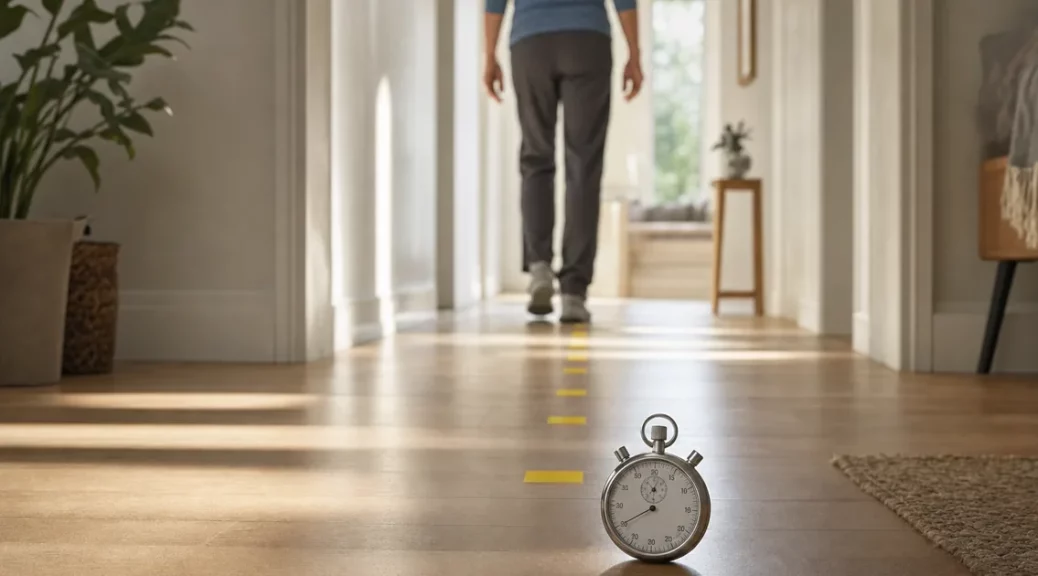
- Mark a 10 m lane in a hallway or driveway with tape. Put line A at 2 m and line B at 8 m, leaving acceleration and deceleration zones.
- Walk at your usual pace, not your best pace, starting well before line A.
- Time from A to B (6 m). Timing a longer middle segment reduces stopwatch error compared with a 4 m course.
- Do three trials, rest 30 seconds between, and average them. Speed = 6 divided by seconds.
- Add the dual-task trial: same walk, counting backward from 100 by sevens out loud. Dual-task cost (%) = (usual speed minus dual-task speed) divided by usual speed, times 100.
- Log four numbers quarterly: usual speed, dual-task speed, cost, and shoes worn. Same hallway, same shoes, same time of day.
Mistakes to avoid
- Walking your fastest. Maximum gait speed is a different measure with different norms. All the cohort data above is usual pace.
- Using a phone or watch "walking speed" metric. GPS and step-based estimates average over minutes of real-world walking, including stops and turns. They are not comparable to a timed lane test.
- No acceleration zone. Timing from a standing start inside the measured segment inflates your time and makes you look slower than you are.
- Testing once. One value tells you almost nothing. A drift of 0.05 to 0.10 m/s across three or four quarterly measurements is the signal.
- Treating a low number as a diagnosis. Slow gait has many causes: hip arthritis, neuropathy, a beta-blocker, a bad month of sleep. A persistent decline is a reason for a clinical conversation, not a self-diagnosis.
- Ignoring the drivers. A 2026 cross-sectional analysis in Nursing & Health Sciences found depressive symptoms, sleep disturbance and pain interference clustered with frailty, with sleep disturbance sitting on the path between mood and frailty. It is cross-sectional and cannot establish direction, but it names the right things to check when your number drops.
What moves the number
Established: loaded lower-body strength work. A meta-analysis in BMC Geriatrics found resistance training progressed to 70 to 80% of one-rep max improved preferred gait speed by 0.13 m/s (95% CI 0.09 to 0.16), above the 0.10 m/s substantial-change threshold. In the LIFE trial, 1,635 sedentary adults aged 70 to 89 randomised to structured walking plus strength and balance work had less major mobility disability than a health education group over an average 2.6 years.
Emerging: breaking up sitting. A systematic review and three-level meta-analysis published in the International Journal of Behavioral Nutrition and Physical Activity in July 2026 pooled 21 randomised crossover trials (433 participants) and found brief standing or activity breaks improved executive function (Hedges' g = 0.18) and memory (g = 0.37) versus continuous sitting, with certainty of evidence rated low to very low. Effects were acute, and higher break frequency tracked with better executive-function outcomes. Treat this as a plausible way to blunt the afternoon drop-off, not as a cognitive enhancer.
Personal experimentation: a 12-week loop. Measure baseline in week 0. Then run two heavy lower-body sessions per week (squat or leg press, split squat, calf raise, plus a loaded carry), one weekly session of brisk walking with three or four 30-second faster surges, and a movement break every 45 minutes of desk work. Re-measure in week 12.
A worked example of what that looks like: baseline usual speed 1.18 m/s, dual-task 0.96 m/s, cost 19%. Week 12: 1.29 m/s usual, 1.12 m/s dual-task, cost 13%. The usual-speed gain of 0.11 m/s clears the substantial-change threshold; the falling dual-task cost is the more interesting number, and the one worth watching over years.
Observable markers to track
- Usual gait speed, quarterly, in m/s, same lane and shoes.
- Dual-task cost as a percentage, quarterly.
- Estimated one-rep max or top working weight on one lower-body lift, monthly.
- Number of sitting bouts longer than 60 minutes per workday, weekly.
- Sleep duration and any pain that changes how you walk, logged alongside each test.
Start this week
Tape a 10 m lane tonight and record four numbers: usual speed, dual-task speed, cost, and the date. Book two lower-body strength sessions into next week's calendar. Set a 45-minute desk timer. Then leave the tape on the floor and repeat in three months. The value is not in today's number; it is in owning a curve that most people never draw, on a system that responds to training long before any scan would tell you something changed.
Sources
- Gait Speed and Survival in Older Adults, JAMA 2011 (PubMed)
- The Trajectory of Gait Speed Preceding Mild Cognitive Impairment, Arch Neurol 2010
- Association of Dual Decline in Cognition and Gait Speed With Risk of Dementia, JAMA Netw Open 2022
- Meaningful Change and Responsiveness in Common Physical Performance Measures, JAGS 2006
- Improvement in Usual Gait Speed Predicts Better Survival in Older Adults, JAGS 2007 (PubMed)
- Normal Walking Speed: A Descriptive Meta-Analysis, Physiotherapy 2011 (PubMed)
- Gait Impairment and Alzheimer's Disease Pathology, Geriatr Gerontol Int 2026 (PubMed)
- Longitudinal Association Between Brain Amyloid-Beta and Gait, Mayo Clinic Study of Aging, J Gerontol A 2018 (PubMed)
- Association of Dual-Task Gait With Incident Dementia in MCI, JAMA Neurol 2017 (PubMed)
- Acute Cognitive Effects of Interruptions to Prolonged Sitting, Int J Behav Nutr Phys Act 2026 (PubMed)
- What Type of Exercise Can Improve Preferred Gait Speed in Older Adults? BMC Geriatrics 2015
- Effect of Structured Physical Activity on Prevention of Major Mobility Disability (LIFE), JAMA 2014
- Symptom Clusters and Frailty Among Older Adults, Nurs Health Sci 2026 (PubMed)
- Why Zero Coronary Calcium Does Not Mean Zero Risk, Peter Attia MD
- Motoric Cognitive Risk Syndrome and the Risk of Dementia, J Gerontol A 2013 (PubMed)