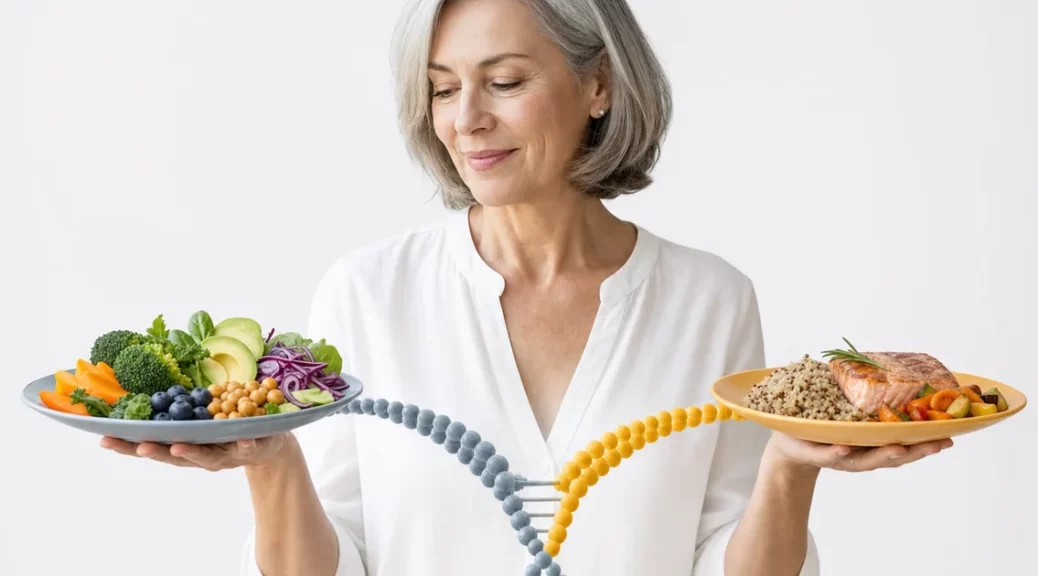
Why Your APOE Genotype May Change What Your Brain Needs From Your Plate
Most nutrition advice for the brain is written as if every brain were the same. A growing line of research says that assumption is wrong, and the gene most responsible is one you may already know by name: APOE. A 2026 cohort study added a concrete, if preliminary, example. The food that tracked with slower cognitive decline did so almost entirely in people carrying the ε4 variant, and barely at all in everyone else. That is worth understanding before you copy anyone's longevity diet wholesale.
What your APOE genotype actually controls
APOE codes for apolipoprotein E, the protein that ferries cholesterol and other lipids between cells. The variant you carry (ε2, ε3, or ε4) is inherited, one copy from each parent. About a quarter of people of European ancestry carry at least one ε4 allele, and roughly 2 to 3 percent carry two copies, according to the Alzheimer's Drug Discovery Foundation's Cognitive Vitality summary of the literature.
ε4 is the strongest common genetic risk factor for late-onset Alzheimer's disease. One copy is associated with a two- to threefold higher risk; two copies, a ten- to fifteenfold higher risk. That is a risk factor, not a verdict. Plenty of ε4 carriers never develop dementia, and plenty of non-carriers do.
Here is the part that makes diet plausibly relevant. The brain runs its own, largely sealed-off lipid economy. Because the blood-brain barrier does not let plasma cholesterol cross, nearly all brain cholesterol is made on site, and APOE is the primary protein that shuttles it between astrocytes and neurons. The brain is the most cholesterol-rich organ in the body. So the gene that defines how efficiently your brain moves lipids around is the same gene that defines your dementia risk. That overlap is why researchers increasingly suspect ε4 carriers may be a metabolically distinct subgroup whose brains are more sensitive to what nutrients are available.
The emerging evidence: a gene-by-diet interaction
In March 2026, researchers from the Karolinska Institutet published a longitudinal analysis in JAMA Network Open using the Swedish National Study on Aging and Care in Kungsholmen (SNAC-K). They followed 2,157 adults aged 60 and older, all free of dementia at baseline, for up to 15 years. About 30 percent carried the higher-risk ε3/ε4 or ε4/ε4 genotypes.
The headline finding was an interaction, not a blanket recommendation. Higher total meat intake was associated with a better cognitive trajectory specifically in ε4 carriers (a small positive coefficient, with the strongest signal in episodic memory), while non-carriers showed essentially no association. The statistical test for that gene-by-diet difference was significant (P for interaction = 0.002). At lower meat intake, ε4 carriers carried more than twice the dementia risk of non-carriers; at higher intake, that gap narrowed.
Two numbers keep this grounded. The "high" group ate a median of about 783 grams per week, roughly 110 grams (under 4 ounces) a day. That is a normal omnivorous diet, not a carnivore experiment. And the type mattered: across all genotypes, a higher proportion of processed meat tracked with worse outcomes. The signal was for ordinary, mostly unprocessed meat, not deli slices and sausages.
Now the caveats, because they are large. This is observational. As Prof. Tara Spires-Jones told the UK Science Media Centre, it "cannot prove that the meat consumption was the cause," diet was self-reported (a real problem when early cognitive decline impairs recall), socioeconomic status likely confounds who eats what, and the carrier-group association was only marginally significant. The authors themselves call for intervention trials before any genotype-tailored advice. Treat this as a hypothesis with a plausible mechanism, not settled guidance.
A mini-case: same advice, two outcomes
Picture two 62-year-old friends who both read that "red meat is bad for you" and cut it to near zero. Anna carries ε3/ε4; her friend Lena carries ε3/ε3. Three years later, Anna's B12 has drifted low and her homocysteine has crept up; Lena's labs look unchanged. Nothing in this single study proves Anna's diet caused a cognitive change, but it illustrates the logic: a one-size rule landed differently on two genotypes. The lesson is not "Anna should eat more steak." It is that her nutrient sufficiency deserved monitoring that the generic rule skipped.
A practical, marker-based approach
You cannot act on a genotype you do not know, and you should not act on this study alone. Here is a sequence that respects both.
- Find out your APOE status, deliberately. Consumer genotyping or a clinician-ordered test will tell you. Decide in advance how you will handle the result, ideally with a doctor or genetic counselor, because ε4 information is emotionally loaded and not deterministic.
- Audit processed versus unprocessed first. This is the part of the evidence that points the same direction across genotypes: less processed meat is associated with better outcomes. Cutting bacon, sausage, and deli meat is the low-regret move regardless of your genotype.
- Check brain-relevant nutrient markers. Ask for serum B12, homocysteine, and ferritin. Meat is a dense source of B12, heme iron, zinc, and creatine; if you eat little of it, these are the gauges that tell you whether you are actually deficient rather than guessing.
- Hit a real protein target. Aim for adequate daily protein from whole-food sources (animal or a well-planned plant mix), tracked for a week so you know your true intake instead of assuming.
- Do not forget the cardiovascular side. Because APOE governs lipid transport, ε4 carriers should keep ApoB and LDL particle burden in view with their clinician. "Meat may help my brain" is never a license to ignore atherosclerotic risk.
Observable markers to track over 6 to 12 months: serum B12 in range, homocysteine not rising, ferritin adequate, ApoB controlled, and grip strength or a simple strength benchmark holding steady as a proxy for protein sufficiency.
Mistakes to avoid
- Treating ε4 as destiny. It shifts probabilities; it does not seal them.
- Reading the study as "eat more bacon." Processed meat pointed the wrong way in the same dataset.
- Using your genotype to justify a carnivore diet. The "high" group ate under 4 ounces a day, not a meat-only regimen.
- Acting on one observational study. The authors explicitly want trials first; so should you.
- Dropping meat to zero without checking labs. If you choose a low-meat diet, supplement and monitor B12, iron, and B-vitamins rather than assuming you are covered.
- Ignoring ApoB because "meat is fine now." The lipid risk does not disappear just because one cognition signal looked favorable.
Personal experimentation
If you are an ε4 carrier and intrigued, the defensible experiment is narrow: ensure nutrient sufficiency rather than chasing a number on a scale of meat. Run the labs above, correct any genuine deficiency, favor unprocessed over processed protein, and re-test in two to three months. Keep your clinician in the loop, especially on the lipid side. That is experimentation with guardrails, not a diet built on a single headline.
Sources
- Karolinska Institutet press release, High meat consumption linked to lower dementia risk in genetic risk group (2026): https://news.ki.se/high-meat-consumption-linked-to-lower-dementia-risk-in-genetic-risk-group
- SNAC-K analysis, APOE-Genotype Modifies the Association of Meat Consumption with Cognitive Decline (PMC, 2026): https://pmc.ncbi.nlm.nih.gov/articles/PMC12726212/
- Science Media Centre, expert reaction to the JAMA Network Open meat/APOE study: https://www.sciencemediacentre.org/expert-reaction-to-study-looking-at-meat-consumption-and-measures-of-cognitive-health-by-apoe-genotype-as-published-in-jama-network-open/
- Alzheimer's Drug Discovery Foundation, Cognitive Vitality, What APOE Means for Your Health: https://www.alzdiscovery.org/cognitive-vitality/blog/what-apoe-means-for-your-health
- APOE and Alzheimer's Disease: From Lipid Transport to Physiopathology and Therapeutics (PMC): https://pmc.ncbi.nlm.nih.gov/articles/PMC7925634/