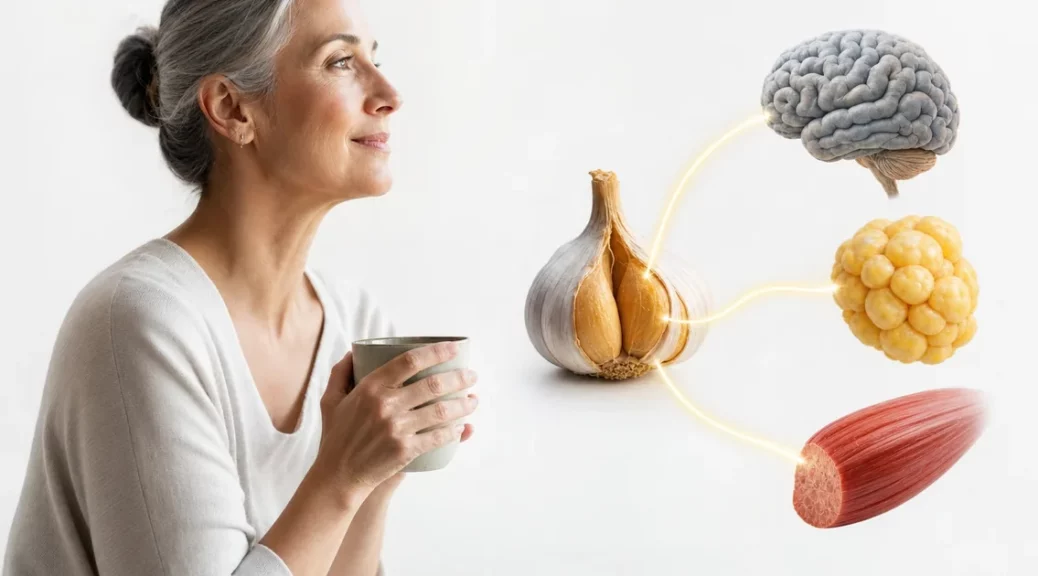
A Garlic Molecule Called S1PC: What the New Aging-Muscle Study Actually Shows
If you follow longevity research, you have heard a lot about NAD — the cellular cofactor that declines as we age and that underpins half the supplement aisle. So when a 2026 paper connected a molecule in aged garlic to NAD biology and to muscle strength in old animals, it traveled fast. The video that probably brought you here, from the channel Physionic, walks through it carefully. This piece does the same thing, with the primary study open in front of us — and it draws a hard line between what's proven, what's promising, and what's still just a reasonable thing to try.
The molecule: S1PC, not allicin
When people say "garlic is good for you," they usually mean allicin, the pungent compound from a freshly crushed clove. This research is about something different: S-1-propenyl-L-cysteine (S1PC), a modified cysteine amino acid that forms when garlic is aged over many months. It is one of the characteristic compounds in Aged Garlic Extract (AGE), the odorless, fermented preparation — not raw garlic and not allicin.
That distinction matters, because everything below is about S1PC specifically.
Established evidence: a fat–brain–muscle relay in mice
The new study was published in Cell Metabolism in May 2026 by researchers at the Institute for Research on Productive Aging in Tokyo and Wakunaga Pharmaceutical (Sato et al., 202600144-0)). In animal models, the mechanism is well-characterized:
How the pathway works
- It starts in fat tissue. S1PC activates an enzyme called LKB1 in white adipose tissue, which in turn promotes the secretion of eNAMPT (extracellular nicotinamide phosphoribosyltransferase) into the bloodstream.
- eNAMPT travels to the brain. Carried in small vesicles, it reaches the hypothalamus, the brain's metabolic control center.
- It supports NAD production. eNAMPT is a rate-limiting enzyme in making NAD, and in the aging hypothalamus that extra supply helps restore NAD levels.
- The brain then signals muscle. With hypothalamic function supported, downstream neural signaling to skeletal muscle improves.
In aged mice, long-term S1PC produced measurable results: increased skeletal muscle force, restored body temperature toward youthful levels, and lower frailty-index scores.
Two background facts here are themselves well-established and worth holding onto. First, NAD declines with age across many tissues, and that decline is tied to weaker DNA repair and energy metabolism. Second, the idea that fat tissue talks to the hypothalamus via circulating eNAMPT is not new to this paper — it's the core of the "NAD World" framework developed over the past decade by Shin-Ichiro Imai and colleagues (npj Aging, 2025). The garlic study slots a dietary molecule into a pathway that was already mapped.
So the mechanism is solid science. The catch is the word that keeps appearing above: mice.
Emerging evidence: a real but narrow human signal
Here is where careful reading pays off. The same study included a randomized, double-blind clinical trial in healthy middle-aged adults. The result: a single oral dose of S1PC-enriched garlic powder raised circulating eNAMPT in the blood — but only in participants who had a healthy body-fat mass to begin with (press release, PR Newswire, May 2026).
That is genuinely interesting. It's the first link from the mouse mechanism to human biology. But notice exactly how narrow it is:
- It measured one biomarker in blood (eNAMPT), not NAD in the brain, and not muscle tissue.
- It was an acute, single-dose test — not weeks or months of supplementation.
- It did not measure strength, mobility, frailty, or muscle loss in people. None of the outcomes that actually matter were tested in humans (NutraIngredients, June 2026).
So the honest summary is: in humans, S1PC nudges a blood marker that sits upstream of the effects seen in mice. Whether that nudge translates into stronger muscles in a 60-year-old is, at this point, untested.
What this study is not
A few guardrails, because the headlines blur them:
- There is no S1PC supplement. Isolated, concentrated S1PC isn't sold, and its safety profile at high doses hasn't been established. The human study used S1PC-enriched garlic powder, not a purified pill.
- This is not a cure for sarcopenia or a replacement for the one intervention with overwhelming evidence for preserving muscle with age: resistance training plus adequate protein.
- Disclose the obvious conflict. A co-sponsor, Wakunaga, manufactures aged garlic products. That doesn't invalidate a peer-reviewed, double-blind result, but it's a reason to wait for independent replication before getting excited.
Personal experimentation: a measured option
This is the part the evidence cannot decide for you, so treat it as a personal log, not a recommendation.
Aged Garlic Extract has been studied for years for cardiovascular markers and is widely available and generally well-tolerated. If you already take it, this research is a mild point in its favor; it is not a reason to start chasing a single biomarker. If you're curious and your clinician has no objection, AGE is a low-stakes thing to trial — but judge it on how you actually feel and perform, not on a mechanism proven only in mice.
What I'd personally not do: buy any product marketing itself as "S1PC for NAD." That product is selling a press release, not a tested intervention.
The bottom line
The S1PC story is a good model of how to read longevity news. Established: the fat–brain–muscle NAD pathway is well-mapped, and S1PC drives it convincingly in aged mice. Emerging: a single human dose moved one blood marker in the right direction. Unproven: that any of this builds or preserves muscle in people.
Your actionable move isn't a new supplement. It's to keep doing the thing this entire pathway is ultimately about — protecting aging muscle — with the tools that already have human proof: lift twice a week, hit your protein, and stay aerobically fit. Aged garlic, if you choose it, is a footnote to that plan. Watch this molecule; don't bet your strength on it yet.
Sources
- Sato et al., "Garlic-derived metabolite activates LKB1, promotes adipose eNAMPT secretion, and improves age-related muscle function via hypothalamic signaling," Cell Metabolism, May 2026 — https://www.cell.com/cell-metabolism/fulltext/S1550-4131(26)00144-0
- PubMed listing for the study — https://pubmed.ncbi.nlm.nih.gov/42102814/
- "Compound Found in Aged Garlic Extract Shows Potential to Improve Muscle Health During Aging," PR Newswire, May 2026 — https://www.prnewswire.com/news-releases/compound-found-in-aged-garlic-extract-shows-potential-to-improve-muscle-health-during-aging-302766561.html
- "Garlic-derived compound shows promise for healthy muscle aging," NutraIngredients, June 2026 — https://www.nutraingredients.com/Article/2026/06/08/garlic-derived-compound-shows-promise-for-healthy-muscle-aging/
- Imai et al., "NAD World 3.0: the importance of the NMN transporter and eNAMPT in mammalian aging and longevity control," npj Aging, 2025 — https://www.nature.com/articles/s41514-025-00192-6
- Physionic, video analysis of the S1PC study (source that inspired this piece) — https://youtu.be/IlWuCN2o_fE