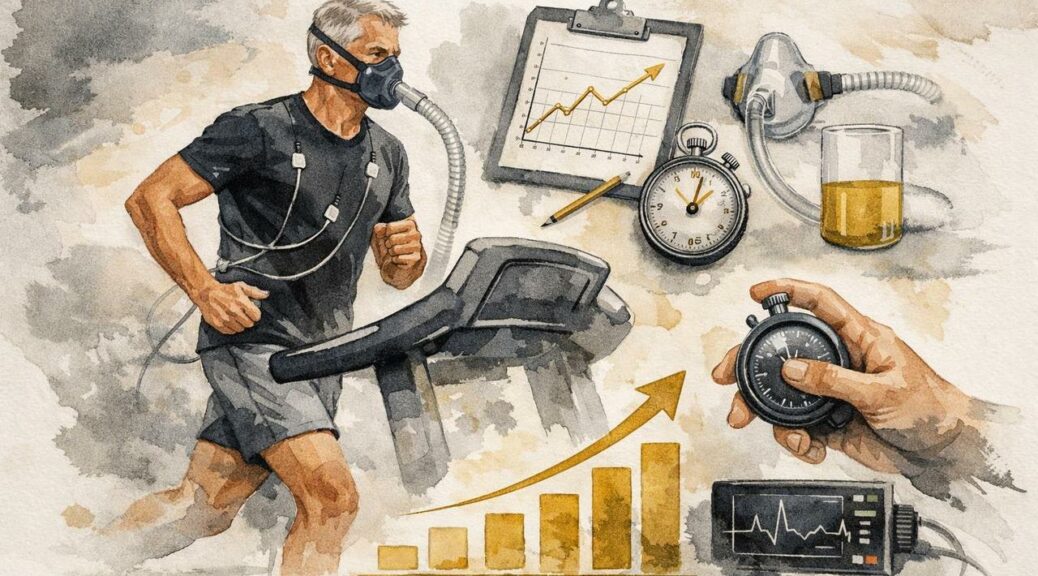
Boost Your VO2max Above 50: Proven Protocol for 50+
Evidence snapshot
- What this article covers: How adults 40+ can raise VO2max with the best-supported training levers.
- Evidence level: Strong.
- Evidence type: Human evidence, including meta-analyses of randomized trials and exercise interventions in older adults.
- Main practical use case: Improving cardiorespiratory fitness, work capacity, and functional reserve after 40.
- Main risk / contraindications: High-intensity work should be scaled carefully if you have cardiovascular disease, uncontrolled hypertension, major orthopedic limitations, or long inactivity.
For adults 40+, VO2max is one of the most powerful fitness markers to improve because it predicts mortality more strongly than almost any other modifiable risk factor. In a Cleveland Clinic study of 122,007 patients followed for a median of 8.4 years, those in the lowest fitness quintile had a 5-fold higher all-cause mortality risk compared with elite performers, and the mortality benefit of moving from low to high fitness exceeded the benefit of not having diabetes or coronary artery disease (Mandsager et al., 2018; PMID: 30376005). The strongest evidence does not support a magic supplement or gadget. It supports training: enough easy aerobic volume to build the base, and enough higher-intensity work to keep pushing the ceiling.
What is known
Structured endurance training improves VO2max in older adults, and the effect is not trivial. A meta-analysis of controlled endurance exercise training studies found that adults over 60 can improve VO2max by an average of 16.3% with regular structured programs (Huang et al., 2005; PMID: 16230876). High-intensity interval training often produces larger gains than moderate continuous training: a systematic review of 160 studies in older adults found HIIT improved VO2max by 5.4 mL/kg/min on average compared to 2.6 mL/kg/min for MICT (Boidin et al., 2021; PMID: 33836261).
The practical takeaway is straightforward: if your goal is a higher VO2max after 40, the highest-confidence interventions are still training frequency, progression, and adherence. Most people do better with a repeatable weekly structure than with heroic one-off efforts. Combining aerobic work with strength training also matters: a systematic review and meta-analysis found that 30-60 minutes per week of muscle-strengthening activities was associated with 10-17% lower risk of all-cause mortality, cardiovascular disease, cancer, and diabetes (Momma et al., 2022; PMID: 36198317).
What remains uncertain
No single protocol is best for everyone. The ideal mix of zone 2 work, threshold intervals, and VO2max intervals depends on current fitness, injury history, recovery capacity, and whether your primary goal is longevity, race performance, weight management, or general health.
Wearables can help with pacing and trend tracking, but they do not replace formal testing. A watch-estimated VO2max can be directionally useful, not definitive. Recovery is another key variable: a meta-analysis of 1,382,999 participants across 16 prospective studies found that sleeping less than 6 hours per night was associated with a 12% higher risk of all-cause mortality (Cappuccio et al., 2010; PMID: 20469800), making sleep quality a non-negotiable part of any serious VO2max training plan.
Main risks and contraindications
The major risk is not that interval training “does not work.” It is that people jump into high-intensity work too aggressively. If you have chest pain, unexplained shortness of breath, known cardiac disease, uncontrolled blood pressure, or you have been sedentary for a long period, get medical clearance before pushing intensity.
At the training level, the common errors are too much intensity, not enough recovery, and using fatigue as a badge of honor. Those mistakes can flatten progression and raise injury risk.
Does zone 2 alone raise VO2max after 40?
It can improve aerobic fitness and support VO2max, especially in less trained adults. Huang et al. (2005) showed significant improvements from moderate endurance training alone, but the ceiling usually rises more when some higher-intensity work is layered in carefully.
How much high intensity is enough for most adults 40+?
For many people, one to two hard sessions per week is enough. Boidin et al. (2021) found HIIT produced roughly double the VO2max improvement of moderate continuous training, but more is not automatically better if it compromises recovery or consistency.
Is VO2max training only for athletes?
No. The strongest argument for improving VO2max after 40 is not athletic vanity. Mandsager et al. (2018) showed that fitness was a stronger mortality predictor than smoking or diabetes. It is preserving aerobic reserve, independence, and health span.
Key sources
- Mandsager et al. (2018) — Cardiorespiratory fitness and long-term mortality among 122,007 patients
- Huang et al. (2005) — Controlled endurance exercise training and VO2max changes in older adults: a meta-analysis
- Boidin et al. (2021) — HIIT vs. MICT on cardiorespiratory fitness in older adults: meta-analysis of RCTs
- Momma et al. (2022) — Muscle-strengthening activities and all-cause mortality: systematic review
- Cappuccio et al. (2010) — Sleep duration and all-cause mortality: meta-analysis of 16 prospective studies
Continue in this cluster
Free guide
The Evidence-Backed Longevity Stack for Adults 40+
Get the practical stack guide and join the evidence-digest request list for adults 40+ focused on longevity, cognition, recovery, and performance.